The Yekke: German-Jewish Heritage & Minhagim
If you have ever davened in a shul where the service runs like clockwork, where every word of every piyut is sung in full, where the chazzan would never dream of skipping ahead, and where the clock on the wall is not a suggestion but a sacred trust, you have likely met the world of the Yekkes — the Jews of Germany. The nickname (its origin is debated, perhaps from the German Jacke, the tailored jacket Western European Jews wore while their Eastern cousins kept long coats) carries a smile and a deep respect. Yekkish Jewry gave the Torah world a whole philosophy of life, a richly preserved minhag stretching back nearly a thousand years, and a reputation for dignity, order, and integrity that survives wherever its grandchildren gather. Whether you are marrying into a Yekkish family, moving near one of its communities, or simply proud of this corner of Klal Yisroel, here is a warm introduction — because at HeimishMart, we are all in this together.
History & Character
German Jewry is among the oldest continuous Jewish presences in Europe, with communities along the Rhine — Speyer, Worms, and Mainz, known collectively as Shum — flourishing already in the medieval period and producing Torah giants whose rulings shaped Ashkenazic practice to this day. Over centuries the community developed a distinctive character: deeply observant yet engaged with the surrounding world, formal in manner, exacting in detail, and devoted to yashrus (uprightness) in business and bein adam la-chaveiro.
The towering figure of the modern era was Rav Samson Raphael Hirsch (1808–1888), who in 1851 took the helm of the Orthodox community of Frankfurt am Main and built it into a fortress of Torah-true Judaism. His banner was Torah im Derech Eretz — the ideal that a Jew steeped in Torah could also live as a cultured, productive member of wider society without compromising a hairsbreadth of halacha. Hirsch founded a kehilla, a school that taught both limudei kodesh and general studies, and a body of writing — including his famous commentary on Chumash and the Nineteen Letters — that still guides Yekkish Jewry. The Holocaust shattered the communities of Germany, but their survivors carried the flame to new shores.
Where They Live Today
The most famous transplant is Washington Heights in upper Manhattan, where German refugees of the late 1930s established a minyan that grew, under Rav Dr. Joseph Breuer — a grandson of Rav Hirsch — into a full kehilla. Founded in 1939, K’hal Adath Jeshurun (KAJ), universally known as “Breuer’s,” took the very name of the famed Frankfurt kehilla and became the standard-bearer of independent Orthodoxy and Torah im Derech Eretz in America. For decades Washington Heights was a thriving Yekkish world of its own; today, while many families have moved to Monsey, Lakewood, and beyond, KAJ remains the heart of the community.
Yekkish life also took root in Eretz Yisroel — in neighborhoods of Yerushalayim, in Haifa, and in Bnei Brak — as well as in England, where German refugees strengthened Anglo-Jewry. Wherever they settled, Yekkes built shuls that guard their ancestral nusach with great care.
Shuls & Nusach
Yekkes daven Nusach Ashkenaz — and specifically, in its most authentic communities, the venerable Minhag Ashkenaz of the Rhineland and Frankfurt, as distinct from the Polish-Lithuanian rite that most “Nusach Ashkenaz” siddurim today actually reflect. The differences are real and beloved: a particular order and wording in tefillah, unique melodies for leining and for the Torah blessings, and a treasury of piyutim recited on the festivals and special Shabbosos that many other communities have long abbreviated or dropped. A Yekkish minyan says them in full.
The atmosphere is one of decorum. Tefillah is unhurried and disciplined; talking during davening is almost unthinkable; the chazzan and the kehilla move together. In keeping with the old Ashkenaz custom, an unmarried man does not yet wear a tallis — a bachur begins wearing the tallis gadol only upon marriage, so the tallis itself marks a milestone in the Yekkish lifecycle — and the shul is adorned with the community’s distinctive customs of dress and order. For a newcomer, the first impression is often of remarkable seriousness and beauty.
Minhagim & Customs
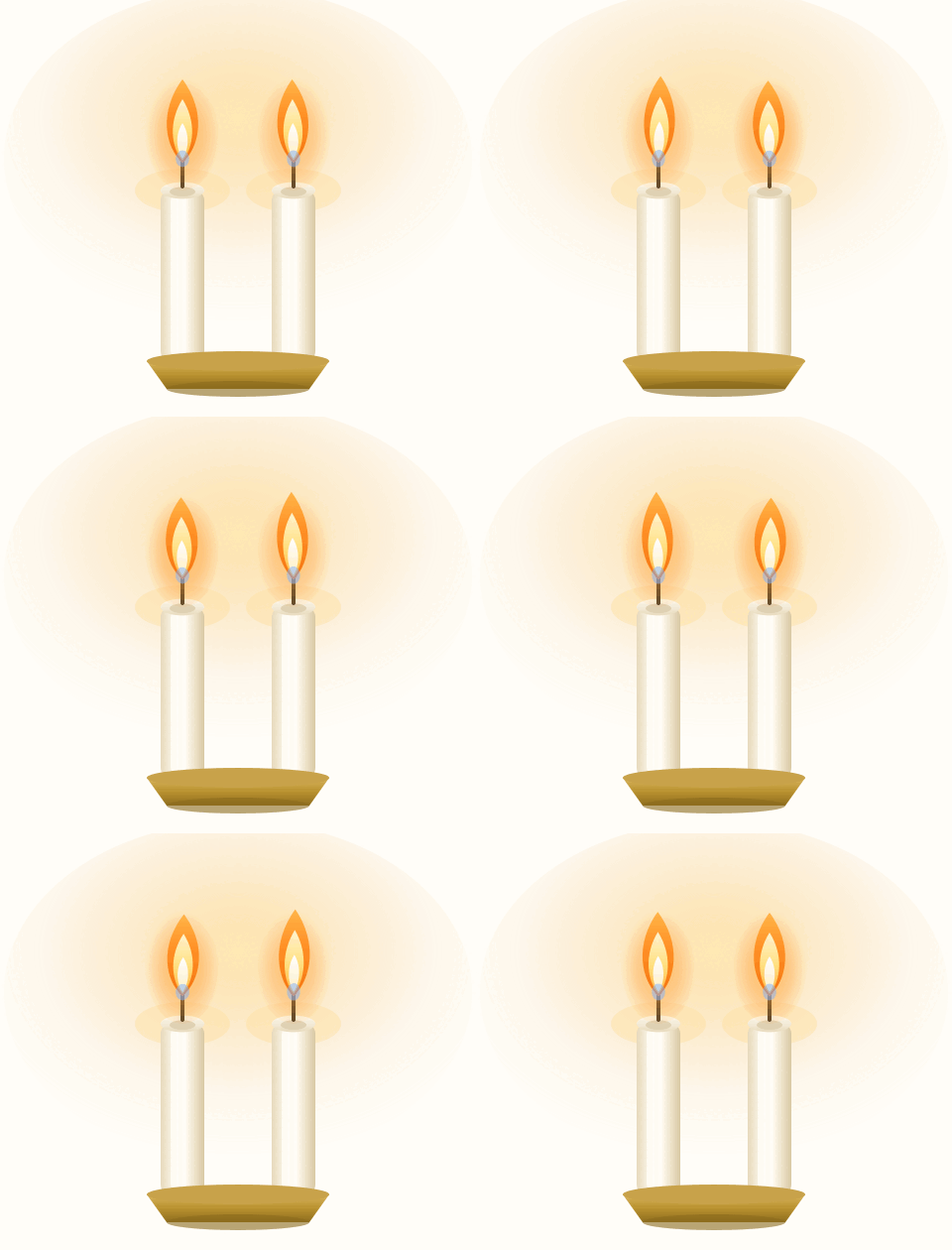
Yekkish minhagim are precise and, to other communities, sometimes surprising. On Shabbos and Yom Tov a woman lights only two candles — corresponding to zachor and shamor — rather than adding a flame for each child, as is common elsewhere. At the Shabbos table Kiddush is made promptly and without delay, and many Yekkes then wash for bread and proceed straight to HaMotzi with no lengthy pause between Kiddush and the meal. Traditionally, Yekkes did not hold an upsherin (the three-year-old’s first haircut), regarding it as a custom borrowed from other communities. And the cherished wimpel — a long Torah binder sewn from a baby boy’s bris cloth, embroidered with his name and a blessing, and presented to the shul when he is old enough to bring it — is a hallmark of the Yekkish lifecycle.
Above all stands the famous Yekkish reputation for precision and punctuality. “Pinktlich” — being exactly on time — is no joke; davening that begins at the posted minute, a clock-like seder ha-yom, scrupulous honesty in money and measure. These are not mere stereotypes but the lived expression of a worldview that holds order and reliability to be expressions of yiras Shamayim.
Foods
The Yekkish kitchen has its own treasures. The Shabbos bread is berches (also called barches) — a sturdy, often potato-based “water challah” made without egg, whiter and denser than the sweet egg challah of Eastern Europe, with a crust that crackles. The cholent tradition lives here too, alongside German-Jewish specialties such as gefilte fish prepared the Western way, and a baking heritage rich in fruit cakes and tarts. Yekkish hospitality pairs its careful order with genuine warmth: a guest is welcomed with precision and with heart.
Lifecycle & Learning
Rav Hirsch’s vision of Torah paired with worldly competence shaped generations of Yekkish chinuch, and Breuer’s in Washington Heights built a full network of mosdos — yeshiva, Bais Yaakov, and kehilla institutions — to carry it forward in America. Yet for decades the fear was that the distinctive Minhag Ashkenaz might fade into the broader Ashkenazic mainstream.
That fear has been answered. In the late 1980s, Rav Binyamin Shlomo Hamburger founded Machon Moreshes Ashkenaz, the Institute for German-Jewish Heritage, in Bnei Brak, devoted to researching, preserving, and transmitting the customs of German Jewry. Its monumental multi-volume work Shorshei Minhag Ashkenaz traces the origins of these practices in scholarly depth, and the institute actively helps minyanim across Israel and the diaspora — in Yerushalayim, Bnei Brak, and beyond — daven and live according to the authentic Ashkenaz rite. Together with KAJ and a growing number of communities, these efforts ensure that the dignity, the piyutim, the wimpel, and the pinktlich spirit of the Yekkes are not a museum piece but a living inheritance — proudly part of the family of Klal Yisroel, and proudly at home among all Jewish homes.
Related Community Guides
HeimishMart is home for all Jewish homes — Ashkenazi, Sephardic, and Mizrahi alike. Explore more:
- The Ashkenazi Jewish World: Heritage, Customs & Community
- The Litvish (Lithuanian) Jewish Tradition
- The Chassidic World: Dynasties, Customs & Community
- The Hungarian & Oberlander Jewish Community
- The Galician & Polish Jewish Heritage
- A Guide to Yiddish: The Mother Tongue of Ashkenaz
- Nusach Ashkenaz & Ashkenazi Minhagim
- The Syrian Jewish Community of Brooklyn
- A Glossary of Sephardic & Mizrahi Jewish Terms
- A Sephardic Pesach: Kitniyot, Rice & What’s Different